July Insights: Nobody Keeps the Streaming Crown for Long
Ask ten executives who “won” streaming in the first half of 2026, and you’ll get ten different answers, because the honest one is that it depends which chart you’re reading, and which week you caught it on. This report draws on Cinelytic’s proprietary streaming data, which tracks global digital demand for films and TV shows across every platform and studio, built from more than 100 million transactions a day. Using the same methodology behind our last two mid-year Insights reports and U.S. domestic data, we lined up three consecutive first halves — January through June, 2024 through 2026 — to see who’s actually gaining ground in streaming consumption, and what audiences are gravitating toward. The picture that comes back isn’t a hierarchy so much as a rotation: almost nobody holds a top spot for two years running, and the companies worth watching closely are the ones building strength in more than one channel at once.
| How we’re counting: rankings reflect each title’s single strongest week of demand in that year’s Jan–Jun window, not average or cumulative performance — this keeps titles comparable regardless of how long they’d been available. Shares are relative to that year’s Top 10, not the total market: Warner Bros’ 18.4% in 2024 means the largest slice of that year’s Top 10, not 18.4% of all streaming. |
First, the Snapshot: Streaming’s Top 10 for H1 2026
Before the three-year lookback, here’s where things stand right now: the Top 10 films and series by U.S. streaming market share for the first half of 2026:
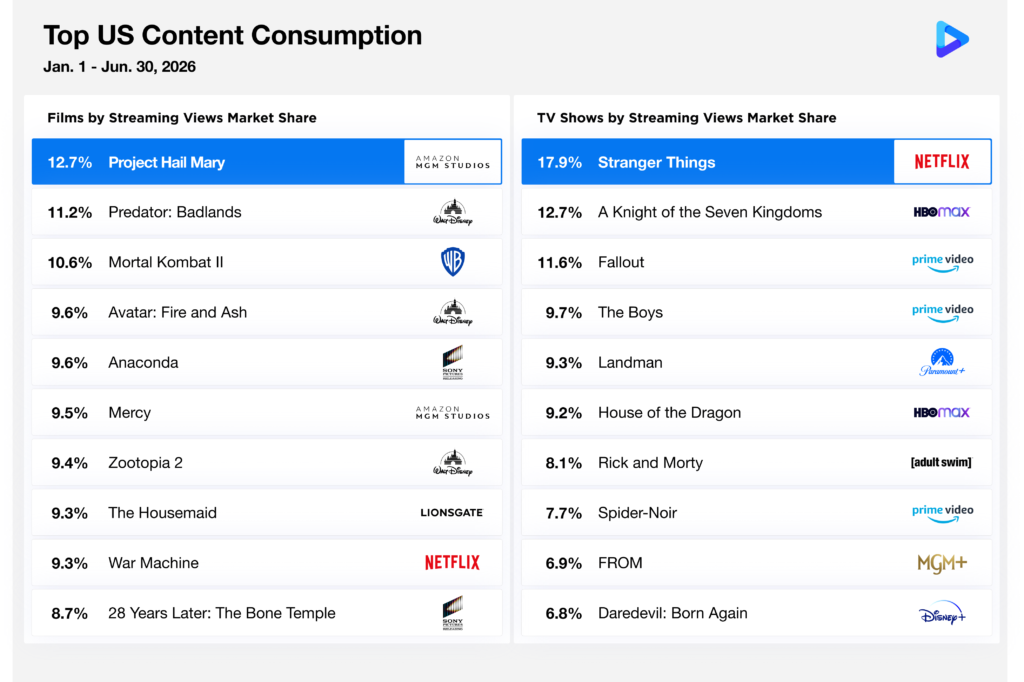
Project Hail Mary topped the film chart at 12.7%, but the more telling number is how it got there: Amazon MGM Studios, Walt Disney Studios, and Sony Pictures Releasing each landed two titles apiece in the Top 10, while Walt Disney alone claimed three counting Predator: Badlands, Avatar: Fire and Ash, and Zootopia 2. That’s not a coincidence: it’s the same pattern this report’s three-year data flags below. Disney and Amazon MGM are the two distributors building sustained streaming strength year over year, and H1 2026 is them showing their work in real time.
On the series side, Stranger Things ran away with it at 17.9%, nearly five points clear of second place, while Prime Video quietly placed three titles in the Top 10 (Fallout, The Boys, Spider-Noir) to HBO Max’s two (A Knight of the Seven Kingdoms, House of the Dragon). Paramount+’s Landman, Adult Swim’s Rick and Morty, MGM+’s FROM, and Disney+’s Daredevil: Born Again round out a list that, unlike the film side, is thinly spread across seven different platforms rather than concentrated among two or three. A single snapshot like this one is useful, but it’s also a trap if you read too much into it, which is exactly why we ran the same math back three years.
Film Distributors: A Three-Year Game of Musical Chairs
Ranked 1–10 each year by each distributor’s share of owned original content within that year’s Top 10, drawn from the Top 100 OTT film releases in the U.S. – the pattern is volatile. No distributor has held the top spot two years running. Warner Bros. led in 2024 with 18.4%, then slid to third in 2025 and fifth in 2026, a steady, uninterrupted decline across all three years. Universal Pictures did the opposite in reverse: it spiked to first in 2025 on the strength of a single title, Wicked, then fell back to sixth in 2026 once that title cycled out of the window. Walt Disney Studios is the exception that proves the rule: climbing every single year, fourth, then second, then first, the only major with a clean, sustained upward trajectory.
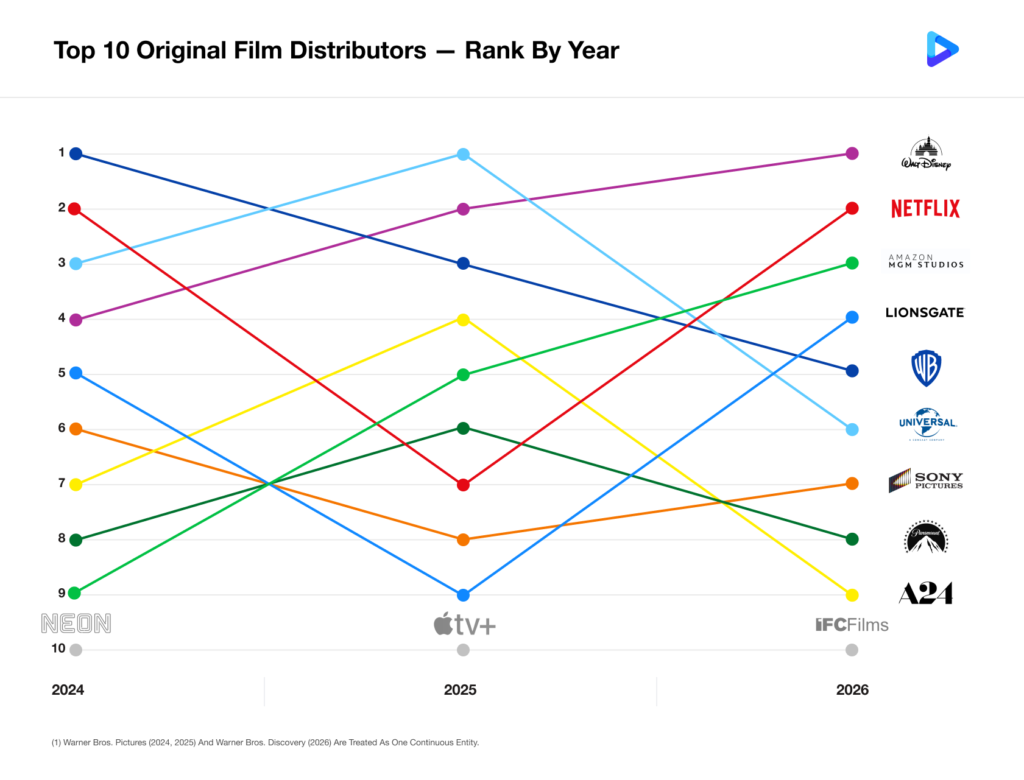
Amazon MGM Studios quietly put together the second-best climb on the chart: ninth in 2024, fifth in 2025, third in 2026, while Lionsgate and A24 both show the volatility typical of specialty and independent distributors, neither having finished in the same rank twice. Lionsgate round-tripped from fifth to ninth and back up to fourth; A24 spiked to fourth in 2025 before falling to ninth in 2026. Netflix dropped from second in 2024 all the way to seventh in 2025 before rebounding to second again in 2026, evidence that its film-distribution share is driven more by a handful of tentpole originals landing (or not landing) in a given window than by steady output. Sony Pictures and Paramount Pictures, by contrast, are the two flattest lines on the entire chart: Sony parked in sixth, eighth, and seventh; Paramount bouncing only between sixth and eighth. Never climbing, never collapsing, just a steady mid-pack position, three years running.
A24’s fall and Neon’s disappearance from the chart after 2024 likely say less about weakening streaming demand than about where these distributors are choosing to compete. Both built their reputations releasing horror theatrically rather than straight to streaming, and both have leaned further into theatrical horror as a box-office draw in its own right. A distributor whose horror slate is winning at the box office has less reason to push those same titles hard onto OTT platforms in the same window, which may explain why both show up among the most volatile, hardest-to-predict lines on this chart rather than steady streaming performers. Every year has also produced its own one-off entrant at the bottom of the Top 10: Neon in 2024, Apple TV+ in 2025, IFC Films in 2026, each earning its single appearance off straight-to-streaming or awards-adjacent titles rather than box-office giants. The bottom of this leaderboard turns over completely every year; the top four or five is where the real stability, or instability, actually lives.
TV Networks: Netflix’s Round Trip, HBO Max’s Hold, and Broadcast’s Sudden Fall
Once again using the same ranking methodology of owned original content as in the film analysis above, one storyline defines this TV chart: CBS’s collapse. The network that led all TV streaming in 2024 with 18.6% (the single highest share any network posted in any of these three years) fell to seventh in 2025 and eighth in 2026, essentially trading places with the platform that replaced it at the top.
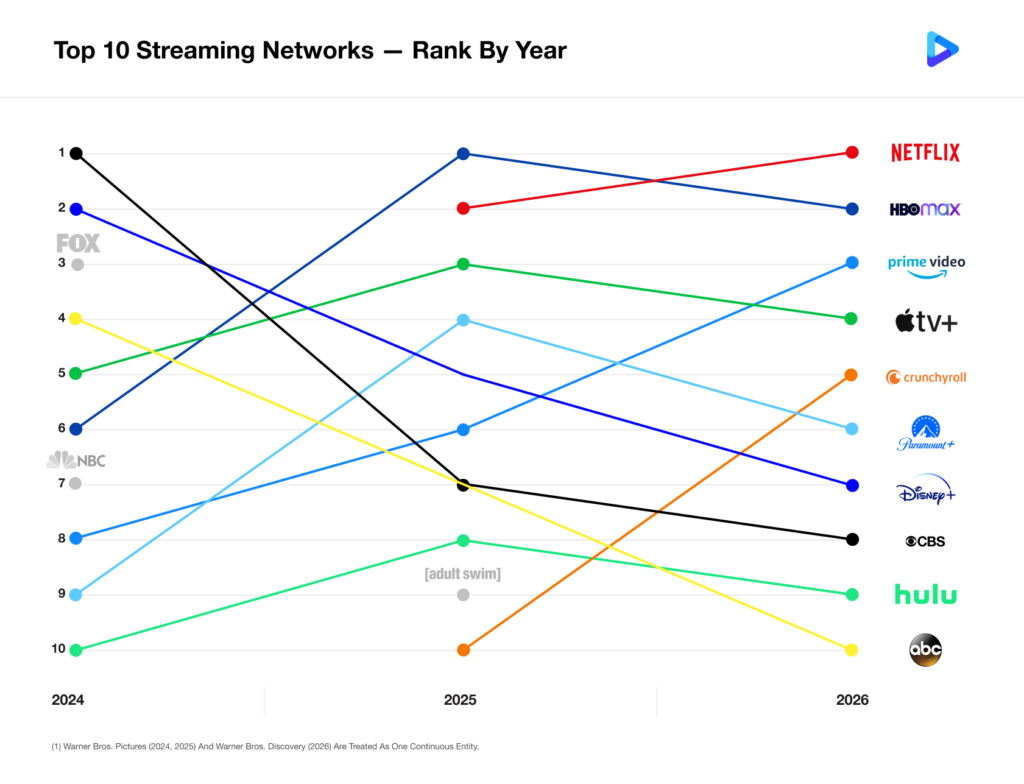
CBS, part of Paramount Global (formerly ViacomCBS), and FOX’s declines are worth pausing on, because a drop that steep, that fast, rarely comes down to weaker shows: it comes down to where the industry’s streaming plumbing was pointed. Both networks’ 2024 numbers leaned heavily on next-day OTT availability of returning broadcast hits at a moment when streaming libraries across the business were still thin, a lingering effect of 2023’s dual strikes pushing new streaming-exclusive originals later into every studio’s release calendar. As that backlog cleared through 2025 and 2026, a wave of in-house streaming exclusives crowded out the kind of broadcast library content that had briefly punched above its weight, and the industry’s broader shift toward keeping next-day streaming rights in-house (counted toward owned platforms like Paramount+ rather than the CBS network brand itself) did the rest. FOX’s disappearance is simpler: without a major streaming service of its own, its 2024 presence traced back almost entirely to a single breakout title with no ongoing pipeline behind it, the same one-off pattern Neon, Apple TV+, and IFC Films show on the film side.
Netflix is the chart’s most dramatic mover in the other direction: absent from the Top 10 entirely in 2024, it jumped straight to second in 2025, then first in 2026, the same 18.6% share CBS posted two years earlier, almost to the decimal. HBO Max shows the inverse of Universal’s film pattern: instead of a one-year spike, it rose from sixth to first and then held onto second, the only network besides Apple TV+ to stay inside the top four every single year. Prime Video put together the single steadiest climb on this entire chart: eighth in 2024, sixth in 2025, third in 2026, a clean three-year rise with no reversal, more likely a run of consecutive hit series than any single breakout title, since Prime Video has placed a show in or near the Top 10 in every window measured here.
Paramount+ improved too, ninth in 2024 up to fifth in 2025 before settling at sixth in 2026, and the timing lines up neatly with the network’s growing “Taylor Sheridan universe”: Landman, a Sheridan production, sits in the Top 10 series list in both 2025 and 2026, giving Paramount+ a recurring, built-in audience the network didn’t have in 2024, a clean example of a single creative voice moving a whole platform’s ranking. Crunchyroll is the sleeper story of the whole report: unranked in 2024, tenth in 2025, fifth in 2026, the fastest sustained climb on either chart. No individual anime title cracked the Top 10 series list directly in this data, which suggests the climb isn’t one breakout hit but broad-based, a deep and growing catalog of anime titles each pulling meaningful streaming demand, in aggregate enough to lift the whole platform’s rank. Hulu, meanwhile, is this chart’s version of Sony and Paramount Pictures on the film side: tenth in 2024, eighth in 2025, ninth in 2026, the flattest line on the board, no breakout, no collapse, just a consistent, unremarkable presence.
Disney+ itself has fallen every year as a standalone brand (second, fourth, seventh), mirroring Warner Bros.’s steady decline on the film side, though that brand-level view understates Disney’s real footprint, since Disney+, ABC, and Hulu are all competing for three separate slots on the same chart. One distributor is conspicuously consistent in the opposite direction: Apple TV+ has held a top-four spot on the TV network chart in all three years (fifth, third, fourth), one of only two networks to never fall out of the leading pack, yet it appears in the film distributor Top 10 exactly once, cracking the list only in 2025 via three straight-to-streaming titles. Apple is, by a wide margin, a television-first streaming strategy; whatever it’s spending on film hasn’t yet translated into the kind of consistent Top 10 presence its series slate has built.
Theatrical Fate vs. Streaming Success
A few titles from each year’s streaming Top 10, checked against real domestic box office performance, show just how loosely the two businesses are actually connected. Gross figures reflect each film’s full domestic total, combined across years for titles whose release straddled a calendar year-end.
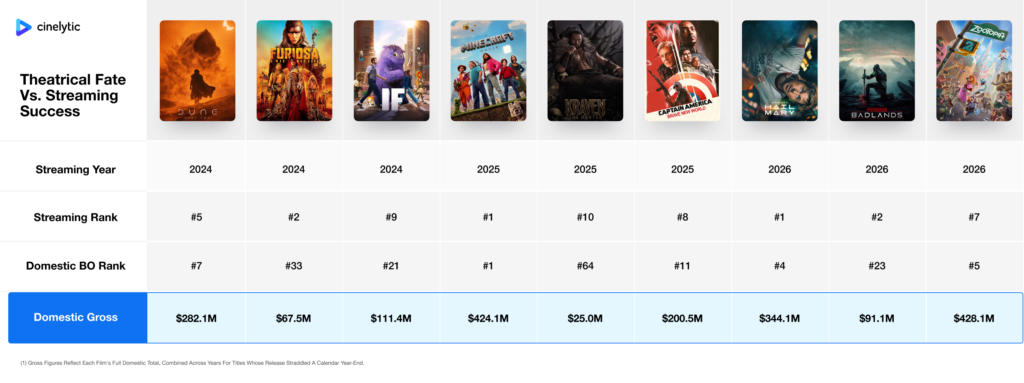
Some titles thrived on streaming despite a rough box-office run: Furiosa finished a modest 33rd domestically in 2024 yet was the second most-streamed film of that year. Kraven the Hunter is the clearest disappointment on this list (a wide release that finished 64th in its own opening year and closed its run at just $25.0M, a real disaster for a comic-book tentpole), yet it still cracked 2025’s streaming Top 10. Predator: Badlands is a milder version of the same shape: a respectable but unremarkable 23rd-place finish still translated into the #2 streaming spot the following year. Across all three years, a weak theatrical showing clearly hasn’t stopped a film from becoming a streaming draw.
Other titles ran the pattern in reverse: strong at the box office, only modestly translating to streaming. Zootopia 2 is the standout case, a genuine blockbuster, the fifth highest-grossing release of 2025 at $428.1M, yet it landed at just #7 the following year, the bottom half of that year’s streaming Top 10. Captain America: Brave New World and IF show a milder version of the same pattern: respectable theatrical runs (11th and 21st place) that only modestly cracked the streaming Top 10 rather than topping it. Dune: Part Two, A Minecraft Movie, and Project Hail Mary show that the pattern doesn’t always split, however: each was a genuine box-office hit that also topped the streaming chart in the same year, proof that the two businesses can move together when a title has the right combination of scale and repeat-watch appeal.
Conclusion: Three Years, One Emerging Order
Across all three years, one company stands apart: Walt Disney Studios is the only distributor to win decisively in both film and television at once. It climbed from fourth to first in streaming film distributor share between 2024 and 2026 while also leading U.S. domestic box office outright in every one of those three years, a level of across-the-board dominance no other studio in this report matches.
Universal Pictures is the clearest counter-example: a consistently strong domestic box-office performer for three years running, yet its streaming film rank swung wildly underneath that stability (third, then a one-year spike to first, then down to sixth), the clearest proof in this data that theatrical strength and streaming share don’t have to move together.
Amazon MGM Studios had the most dramatic rise of any distributor on either side of the business, climbing from ninth to third in streaming film share while also becoming a genuine top-tier domestic box-office player by 2026, building strength in both channels at once rather than trading one for the other.
On the network side, brand-level rank tells only part of the story: all three major conglomerates in this report field more than one network apiece, and Disney’s case is the most striking. Combining Disney+, ABC, and Hulu gives Disney a 28.2% share of the 2024 TV Top 10, comfortably the largest combined total of any company that year. That edge didn’t last: Paramount Global (CBS plus Paramount+, the company formerly known as ViacomCBS) and Warner Bros. Discovery (HBO Max plus Adult Swim) both built comparable multi-network totals of their own by 2025, briefly overtaking Disney’s combined share before all three converged into a near three-way tie by 2026.
HBO Max is the closest thing to a genuinely stable single-brand leader, rising from sixth to first and holding second place afterward. Netflix produced the single most dramatic swing in this report: absent from the TV Top 10 entirely in 2024, then first by 2026, a mirror image of its own round trip on the film side. Traditional broadcast networks collapsed in near unison as standalone brands over the same stretch: CBS under Paramount Global, ABC under Disney, FOX as a standalone, and NBC under NBCUniversal (Comcast) all fell out of favor at once, while Crunchyroll’s rise from unranked to a top-five network tracks with anime’s broader move into the streaming mainstream. A24 is the one distributor whose theatrical and streaming lines moved in genuinely opposite directions: a steadily growing box-office presence paired with an increasingly erratic streaming rank, consistent with a studio choosing theaters over OTT for its biggest titles.
The pattern worth carrying forward isn’t which single company currently sits at #1. It’s that the businesses building strength in both channels at once, Disney most of all and Amazon MGM increasingly, are the ones pulling ahead of the ones still relying on dominance in just one.
Spotting a shift like Amazon MGM’s rise or a broadcast network’s collapse before it shows up in trade headlines is exactly the kind of decision intelligence The Cinelytic Group builds each of our platforms to deliver, whether it be via our territory-level revenue forecasting, or real-time audience and marketing intelligence courtesy of SocialSense360. The data above looks backward; our platforms are built to help you see it coming.